



Tab Article
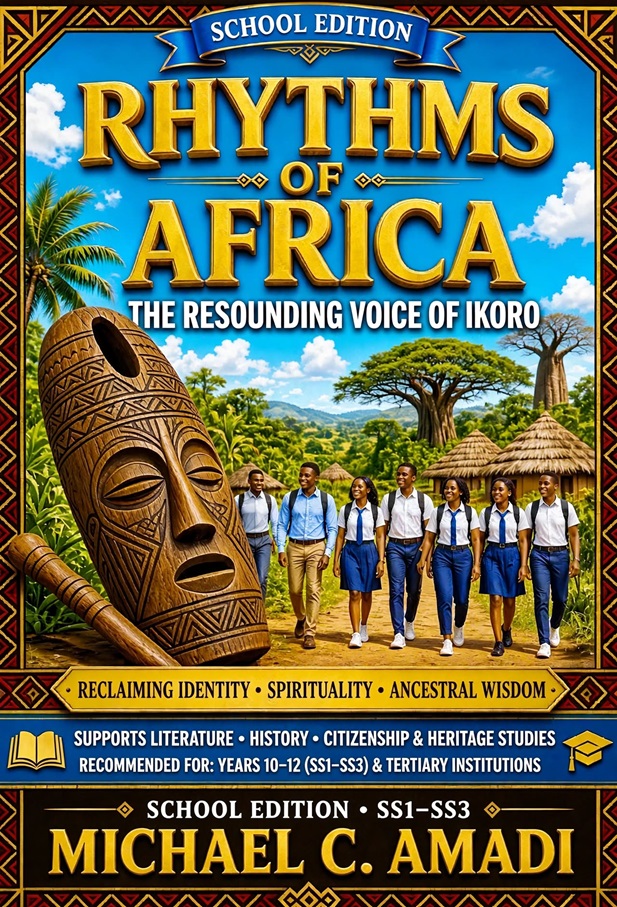
Rhythms of Africa: The Resounding Voice of Ikoro School Edition Reclaiming identity, spirituality, and the forgotten wisdom of a continent. This School Edition is written for senior secondary students, colleges of education, introductory tertiary courses, teachers, and general readers who want a clear, engaging account of Africa’s heritage. The book brings together cultural memory, historical reflection, and narrative storytelling. It explores colonisation and its aftermath, the pressures of the post-colonial era, communal institutions, moral order, proverbs, and the living voice of the Ikoro. Drawing on Igbo and wider Alkebulan tradition, it invites readers to recover dignity, responsibility, and continuity in a world that often treats African history as a footnote to someone else’s story. What you will find inside Early chapters set the historical frame: the impact of European colonial expansion, African resistance, missionary encounter, and the unfinished work of independence. They also address present challenges that shape young lives, including health, security, education, and the need for local capacity in industry and public life, so that heritage is not separated from the questions students face today. Central chapters turn to the texture of communal life. The Ezi and the Obu, farming cycles and the sacred bond with the land, law and coming of age, dispute and peacemaking, festivals such as Iri Ji Ohuo, and community service through the Ozi Obodo are presented as living social technologies. Proverbs appear both with commentary and as a second collection offered as seeds for the reader’s own judgment. Symbols such as ọmụ nkwụ and the broom of cleanliness show how ordinary objects carried moral and spiritual meaning when a community shared the language of respect. Narrative chapters carry the argument through story. Queen Oruka, the orphaned boy Iheajuru, the herbalist’s craft, the Ikoro’s public voice, Egwu Onwa folklore, and the later arcs of merchants, reformers, and households under pressure show courage, integrity, and care for the next generation. These stories are not ornaments. They are the method by which values are remembered and tested. Built for teaching and learning Each chapter opens with learning objectives and closes with review tools: checks of understanding, key terms, and apply tasks suited to discussion and group work. Discussion prompts appear where the text raises questions worth pausing over. A glossary of Igbo and Alkebulan terms supports close reading. Appendices offer figures of speech by chapter, a teacher’s guide, and sample assessment tasks. Further reading points beyond the book without treating this text as a mere digest of other sources. Igbo words and proverbs are retained in their original form so that language remains part of the learning rather than a decoration added at the end. The book can stand alone or sit beside approved materials in History, Cultural Studies, Literature, and related citizenship or heritage courses. A note on approach Some practices from the past are described because understanding requires honesty, not because they are offered for imitation. Fictional kingdoms and characters stand beside real peoples and places that still live; where living communities are named, the book draws on reputation, oral history, and public cultural memory, not on any claim to speak officially for them. The relationship between lived experience, inherited knowledge, historical evidence, and imaginative reconstruction is set out in the front matter for readers and teachers who need that clarity. Africa’s past is not only archive. It is instruction in leadership, justice, work, belonging, and the courage to remain human under pressure. This School Edition is prepared so that young readers, and those who teach them, can hear that instruction again.
 National Library of Nigeria
.jpg) Association of Nigerian Authors
 Nigerian Library Association
 EagleScan
 Crossref