



Tab Article
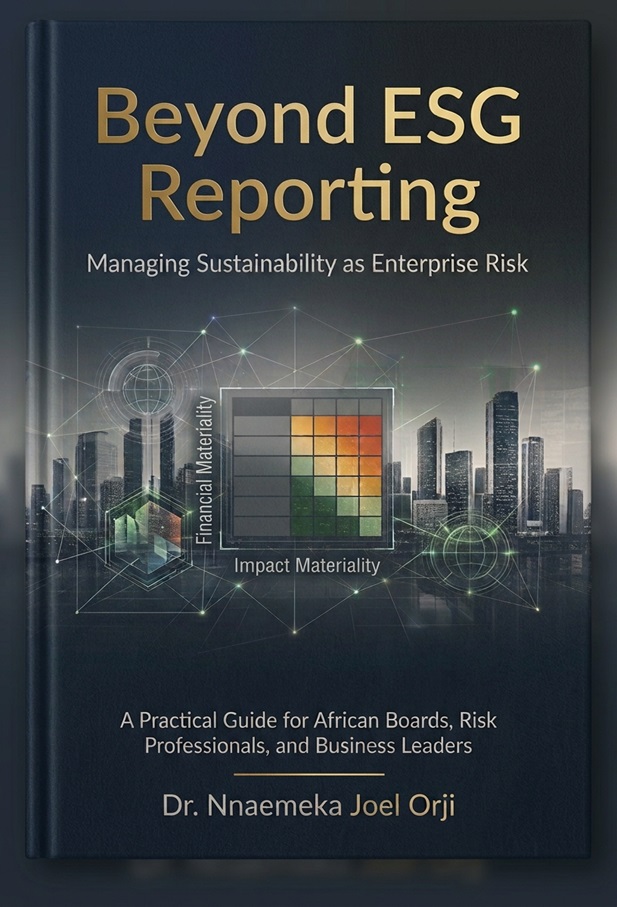
Beyond ESG Reporting: Managing Sustainability as Enterprise Risk (A practical guide for African Boards, Risk Professionals and Business Leaders) Most organizations know how to write an ESG report. Far fewer know how to manage the risks behind it. Boards, regulators, investors, and lenders no longer just want a polished disclosure. They want proof that the risks behind it are governed and controlled. The question has shifted from “Do you publish an ESG report?” to: “Can you demonstrate that your sustainability risks are managed as rigorously as your financial and operational risks?” The Real Problem Organizations spend months preparing sustainability reports, then struggle to answer the questions that matter most: Where does this data come from? Who owns the risk? What controls support it? Is the Board getting what it needs to decide? Most organizations don’t have an ESG reporting problem. They have an enterprise risk management problem that ESG reporting has exposed. What Makes This Book Different Most ESG books explain reporting standards and disclosure frameworks. This one answers a more practical question: how do you embed sustainability into the systems that already govern your organization — board oversight, enterprise risk management, internal controls, data governance, internal audit, and strategic decision-making? The result: an organization equipped not just to disclose, but to manage the risks that shape long-term performance and resilience. What You'll Learn ✔ Integrate ESG into your Enterprise Risk Management framework ✔ Identify and prioritize the sustainability risks that affect enterprise value ✔ Establish real governance, accountability, and Board oversight ✔ Build credible ESG data, measurement, and control systems ✔ Strengthen Internal Audit’s role in ESG assurance ✔ Prepare for evolving disclosure requirements with confidence ✔ Turn ESG from a compliance obligation into a competitive advantage Inside the Book Part I — The Case and the Shift: Why sustainability is now an enterprise risk issue, and Africa’s evolving regulatory landscape. Part II — The Integration Framework: A practical model connecting Governance, Risk, Controls, Data, Assurance, and Disclosure into one operating framework. Part III — Measurement, Data, and Assurance: Building reliable ESG data systems, climate risk as enterprise risk, and Internal Audit’s assurance role. Part IV — Sector Application: Playbooks for Oil & Gas, Financial Services, Healthcare, and the Public Sector, plus a structured implementation roadmap. Useful Tools Included: ESG Risk Taxonomy · Risk Assessment Matrix · Risk Appetite Statement · KRI Library · Control Framework · Internal Audit Programme Outline · African ESG Regulatory Reference Table Plus: 20 Questions Every African Board Should Ask About ESG Risk Who This Book Is For: Board members, CEOs, CROs and CFOs, Internal Audit and compliance leaders, ESG and sustainability professionals, and consultants or researchers responsible for governance, risk, and resilience — whether starting an ESG journey or strengthening an existing one. Not for you if: you want a general introduction to sustainability concepts. This is a practitioner’s guide for building systems, not a primer. About the Author Dr. Nnaemeka Joel Orji is a Governance, Risk, Audit, and Compliance executive with extensive experience in enterprise risk management, internal audit, and organizational governance across Africa’s healthcare and energy sectors. This book distills years of executive practice into practical solutions, not theory. "The future of ESG is not better reporting. It is better risk management" - Dr. Nnaemeka Joel Orji
 National Library of Nigeria
.jpg) Association of Nigerian Authors
Association of Nigerian Authors Nigerian Library Association
 EagleScan
 Crossref